
You do not need to understand algorithms, own an expensive computer, or have written a line of code before beginning software development. Harvard’s CS50, one of the most widely used introductory computer-science courses, explicitly accepts students with no previous programming experience; roughly two-thirds of its CS50x students have never studied computer science before.
That matters because the hardest part of how to start learning software development with no prior experience is usually not intelligence or mathematics. It is deciding what to learn first without drowning in languages, frameworks, courses, and conflicting advice.
The simplest route is surprisingly narrow: choose one direction, learn one language, write code frequently, and start building things before you feel ready.
First, Understand What Software Development Actually Requires
Programming is only one part of software development.
A developer must eventually learn how to break a problem into smaller pieces, write instructions a computer can execute, find mistakes, organize code, save changes safely, work with data, and understand how different parts of an application communicate.
You do not need to learn all of that during your first month.
Your initial goal should be much smaller: become comfortable turning a simple idea into working code.
For example, instead of deciding that you need to “learn Python,” set a concrete goal such as creating a program that asks for three expenses and calculates the total. That forces you to learn variables, input, numbers, calculations, and output in context.
This project-first approach gives abstract programming concepts somewhere to stick.
Choose Your First Language Based on What You Want to Build
Beginners often spend too much time asking which programming language is “best.” There is no universal answer.
Two options make especially practical starting points.
Choose Python for General Programming
Python is useful for automation, scripting, data analysis, back-end applications, and many AI-related workflows. The Python Software Foundation describes it as approachable for beginners and provides official getting-started resources.
Its readable syntax also means beginners can spend more time thinking about programming logic and less time deciphering punctuation.
Start with Python if you want to automate repetitive tasks, explore data or learn general programming before choosing a specialty.
Choose JavaScript for Web Development
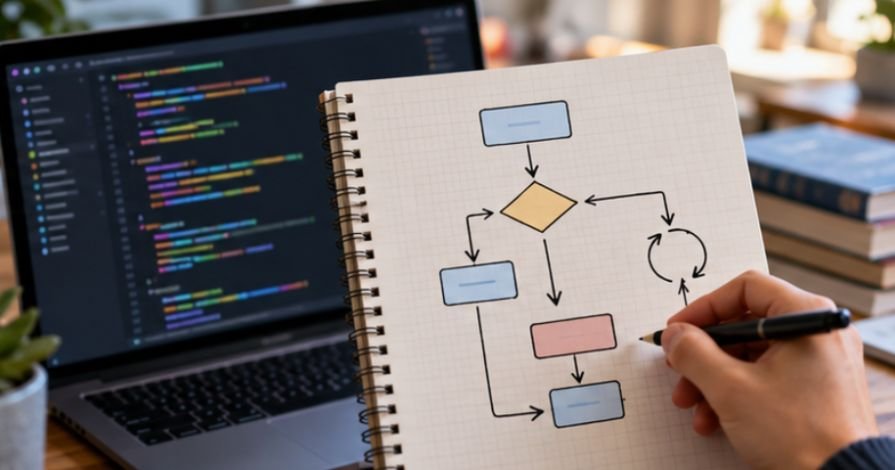
If your motivation is building websites or browser-based applications, JavaScript gives faster visual feedback.
Mozilla’s developer documentation explains that JavaScript powers interactive website behavior such as forms, buttons, animations, dynamic content and many other browser features.
JavaScript can also run outside the browser, making it possible to use the same language in both front-end and server-side development.
Do not learn Python and JavaScript simultaneously during your first few weeks. The concepts overlap, but switching syntax constantly creates unnecessary cognitive load.
Use a 12-Week Beginner Roadmap
A beginner does not need a perfectly optimized curriculum. You need enough structure to prevent random learning.
Here is a realistic starting framework.
| Weeks | Main Focus | What You Should Be Able to Do |
| 1–3 | Syntax and logic | Use variables, conditions, loops and functions |
| 4–6 | Small programs | Build simple tools without copying every step |
| 7–9 | Git, debugging and data | Track changes, fix errors and work with collections |
| 10–12 | One larger project | Combine several concepts into a usable application |
The exact pace matters less than consistency.
Studying four focused hours every weekend can work. So can 30–45 minutes most weekdays. A schedule you can repeat for six months is more useful than an exhausting two-week sprint.
Spend Less Time Watching and More Time Typing
Tutorials create a dangerous illusion: code looks obvious while someone else is writing it. Then the video ends and the empty editor suddenly feels impossible.
Avoid that gap by using a simple 50/50 rule. For every hour of instruction, try to spend approximately another hour solving exercises, changing examples or building something independently.
Structured courses can still provide the backbone. Harvard’s CS50 teaches problem solving, algorithms, data structures, Python, SQL and web technologies rather than concentrating exclusively on language syntax. MIT OpenCourseWare likewise provides introductory programming courses centered on Python before pointing learners toward algorithms and software construction.
The lesson is not that you must complete both. Pick one structured pathway and actually finish substantial portions of it.
Build Projects Before You Think You Are Qualified
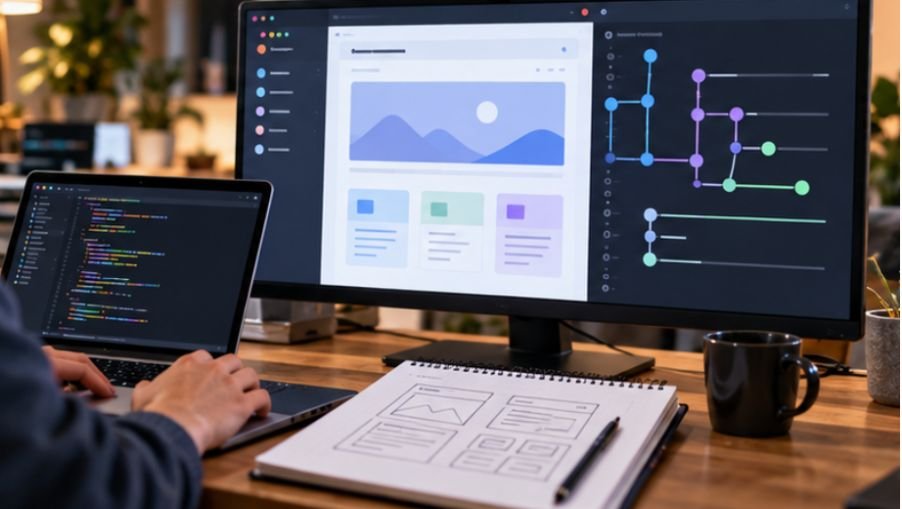
Waiting until you “know enough” to build software creates tutorial dependency.
After learning variables, conditionals, loops and functions, you already know enough to create deliberately small programs.
Try a tip calculator, quiz, expense tracker, number-guessing game, unit converter or personal task list.
Then make version two.
Add input validation. Store information. Improve the interface. Break repeated code into functions. Fix something that fails unexpectedly.
That second iteration is where software development begins to feel different from completing lessons.
A project also exposes gaps that tutorials hide. You discover that knowing what a loop does is different from recognizing when your own program needs one.
Learn Git Earlier Than Most Beginners Do
Git is a version-control system: it records changes to files so earlier versions can be reviewed or restored. The official Git documentation explains that version control lets developers compare changes, recover previous states and identify when modifications were introduced.
You do not need to master Git immediately.
Learn five ideas first:
git init
git add
git commit
git status
git log
Once those feel normal, learn how remote repositories work and begin storing your practice projects online.
Once you understand repositories and version control, it is useful to see how these tools support collaborative development.
This introduction to how open source software works for beginners explains how repositories, branches, pull requests, maintainers, and licensing come together in real-world software projects.
This develops a habit used in professional development while protecting you from the classic beginner disaster: “I changed something and now nothing works.”
Keeping development tools and applications current is another important part of maintaining a reliable software environment.
Learning how to check if computer software is outdated enables beginners to identify obsolete versions that may lack critical bug fixes, security patches, and compatibility enhancements.
Add Computer Science Concepts Gradually
Do not begin by memorizing dozens of algorithms.
Once basic programming feels comfortable, start learning why certain approaches work better than others.
Study arrays or lists, dictionaries or objects, stacks, queues, searching, sorting, basic runtime complexity and recursion.
Then add databases, basic SQL, HTTP requests and application programming interfaces.
The goal is not academic trivia. These concepts explain why real programs behave the way they do.
Before moving into more advanced concepts, it helps to establish a clear understanding of how software itself is structured and how its core components interact.
This learning about software for beginners resource provides a practical foundation covering software, hardware, operating systems, applications, files, and fundamental programming concepts.
Harvard’s beginner curriculum deliberately moves from fundamental programming into arrays, algorithms, memory, data structures, Python, SQL and web development. That progression shows why foundations should precede frameworks.
Do You Need a Computer Science Degree?

Not necessarily to learn programming, but career requirements deserve more nuance.
The U.S. Bureau of Labor Statistics says software developers typically need a bachelor’s degree in computer and information technology or a related field. It also reports a median annual U.S. software-developer wage of $135,980 in May 2025 and projects employment for software developers to grow 10% between 2025 and 2035.
That does not mean every employer has identical requirements. Hiring standards vary by company, role and experience level.
Self-taught learners should therefore avoid assuming that completing several online courses automatically makes them job-ready. Strong projects, debugging ability, fundamental knowledge and evidence that you can build independently matter far more than collecting dozens of certificates.
Frequently Asked Questions
1. How long does it take to learn software development from scratch?
Basic programming can become familiar within several months of consistent practice. Becoming employable generally takes longer and depends on study time, project quality, specialization and previous technical experience.
2. Is Python or JavaScript better for beginners?
Python is excellent for general programming and automation. JavaScript is especially useful for web development. Pick based on what you want to build rather than trying to learn both immediately.
3. Do I need advanced math to become a software developer?
Not for most beginner software projects. Basic logical reasoning is more immediately important. Specialized areas such as graphics, machine learning or scientific computing may require stronger mathematics later.
4. Can I learn software development for free?
Yes. Universities, professional organizations and open-learning platforms provide extensive free material. The bigger challenge is maintaining a structured learning path and practicing instead of repeatedly switching resources.
Start Smaller Than Your Ambition
The biggest beginner mistake is designing a learning plan that resembles a four-year degree before writing a useful program. Start smaller. Choose Python or JavaScript. Learn the basic syntax. Build one tiny application. Break it. Debug it. Put it under version control. Then build a slightly harder one.
Learning how to start learning software development with no prior experience ultimately means accepting that confusion is part of the process. You are not supposed to understand the entire technology stack before beginning. Your first program may be 15 lines long and unimpressive to everyone else. If you wrote it, debugged it and understand why it works, however, it has already taught you something another ten hours of passive tutorials cannot.
Leave a Reply