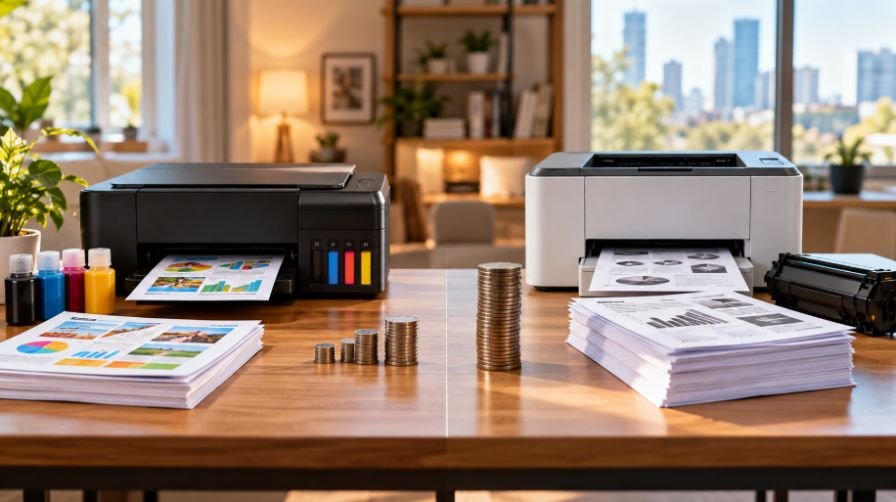
I used to think the cheapest printer was the one with the lowest price tag. After comparing ink bottles, toner cartridges, and how often each machine gets used, I realized the purchase price tells only part of the story.
I also noticed that printer choice changes with printing habits. Someone printing a few pages each month has different needs from a home office producing color handouts every week. That is why an ink tank vs laser printer running cost comparison needs to consider volume, color, maintenance, and time.
Where Printer Running Costs Really Come From
The simplest way to compare printers is to calculate cost per page. Divide the price of a consumable by its rated page yield, then consider how many pages you expect to print. A $50 cartridge producing 2,000 pages can be cheaper than a $20 cartridge producing 400 pages.
Ink tank printers change that equation because they use refillable reservoirs and bottles instead of conventional cartridges. The initial printer price can be higher, but low consumable costs can offset that difference.
Laser printers use toner rather than liquid ink. A monochrome laser can be efficient when the workload is mostly black text, such as forms, invoices, shipping labels, and office documents. Toner cartridges usually cost more at checkout, but their page yields can also be substantial.
Ink Tank vs Laser Printer Running Cost
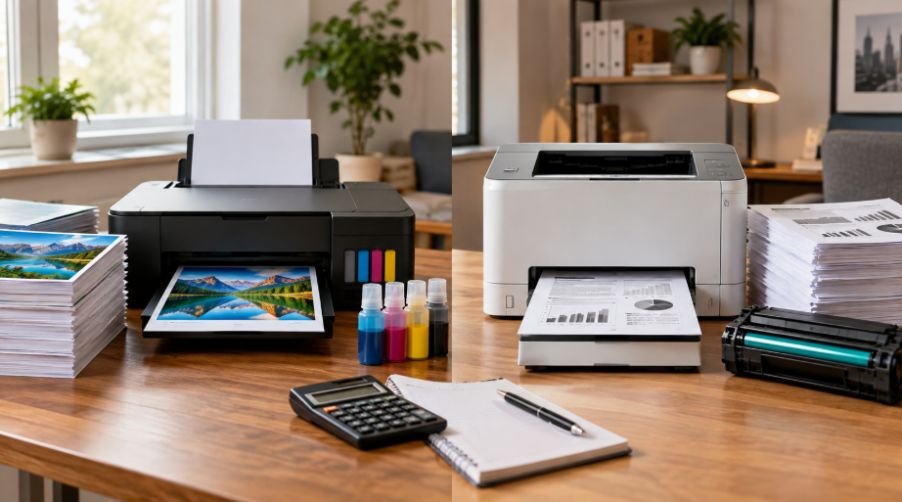
The difference becomes clearer when the comparison is made over thousands of pages instead of one refill. A printer that looks expensive can become less costly once supply purchases are included. That is relevant for users who print every week rather than occasionally.
For color printing, refillable ink tanks generally have a strong operating-cost advantage. One bottle can replace many traditional cartridges, and the printer can continue working after a simple refill. This makes an ink tank attractive for families, students, and small offices that regularly print presentations, charts, worksheets, and other color material.
Monochrome laser printers remain compelling when color is rarely needed. Their toner is dry, so it does not evaporate or dry inside a printhead while the machine sits unused.
Color laser printers complicate the calculation. They require multiple toner colors, and replacement cartridges can be expensive. For users who need frequent color output but do not need laser speed, a refillable ink tank can offer a lower ongoing consumables bill.
What Changes the Cost Over Time
Monthly print volume is one of the biggest variables. Someone printing 30 pages a month may never recover a higher upfront cost through cheaper supplies. A household printing several hundred pages monthly has more opportunity to benefit from low-cost refills.
Print content matters too. A page filled with dense graphics consumes considerably more ink than a basic text page.
Maintenance also deserves attention. Inkjet systems can perform cleaning cycles, particularly when printheads need maintenance. Extended periods without printing can increase the risk of ink-related problems. Laser printers do not have liquid ink that can dry out, although some models eventually require drums, waste-toner components, or other service parts.
Real costs still depend on coverage, settings, document types, maintenance, and the specific printer.
Home Printing: Which Cost Structure Fits?
Occasional home users should think about how often the printer will actually run. If most printing consists of a handful of black documents every few weeks, a compact monochrome laser may provide a straightforward ownership experience.
A home that regularly prints school projects, recipes, forms, photos, colorful invitations, or graphics has a different equation. In that setting, an ink tank can make sense because the low cost of bottled ink becomes more valuable as color volume increases.
For better results when printing photos at home, it is also worth learning how to choose photo paper for home inkjet printers, since paper type and finish can affect print quality and overall cost.
Estimate monthly pages, separate color from black-and-white output, and compare actual consumables.
Small Offices Need a Broader Calculation
Small businesses should also consider workflow. An office producing invoices and internal documents may favor a monochrome laser because speed, dependable text printing, and long periods of inactivity can matter more than inexpensive color.
A design-oriented office, tutoring business, home-based service, or small operation producing frequent color paperwork may benefit from an ink tank.
For professionals who need to print while working away from the office, best portable printers for remote work and travel can offer a convenient option for handling documents on the go.
Before buying, check rated yields, replacement-part costs, duplex capabilities, print speed, and the manufacturer’s recommended duty cycle. Also consider whether the printer includes starter ink or toner to make the first year representative of ownership.
How to Calculate Your Break-Even Point
Start with the price difference between two printers. Then estimate annual pages and multiply that figure by the difference in consumable cost per page. If annual savings are greater than the extra purchase price, the more expensive printer can recover its premium over time.
For example, if one printer costs $100 more but saves five cents per page, it would need roughly 2,000 pages to recover that initial difference. The calculation becomes more useful when based on your actual printing habits.
For shoppers focused on minimizing consumable spending, comparing models within the refillable category can also be useful. The best refillable ink tank printers for low-cost printing can differ in included ink, replacement bottle pricing, speed, and features, so the cheapest refill may not automatically mean the lowest total cost.
Frequently Asked Questions
1. Are ink tank printers cheaper than laser printers?
Often, yes for color printing. Refillable ink bottles can provide very low per-page costs. Monochrome lasers can remain competitive for black text, especially when color is rarely needed.
2. Which printer is better for occasional printing?
A monochrome laser can be convenient for infrequent document printing because toner does not dry out. An ink tank is more attractive when occasional printing still includes meaningful color output.
3. Do ink tank printers require regular use?
Regular use can help keep liquid-ink print systems operating smoothly. Some printers perform maintenance cycles when needed, which can consume ink.
4. Is toner always cheaper than ink?
No. Toner can be economical for black documents, but refillable ink tanks can deliver very low costs for color printing. The answer depends on yield, supply price, coverage, and volume.
The Cost That Fits Your Routine
Printer economics become clearer when the purchase is viewed as a long-term expense rather than a one-time transaction. An inexpensive machine can become costly if its supplies are expensive, while a pricier model can make financial sense when its consumables match a heavy workload. Match the printer to the pages you actually produce, and the running-cost decision becomes far easier to understand.
Leave a Reply