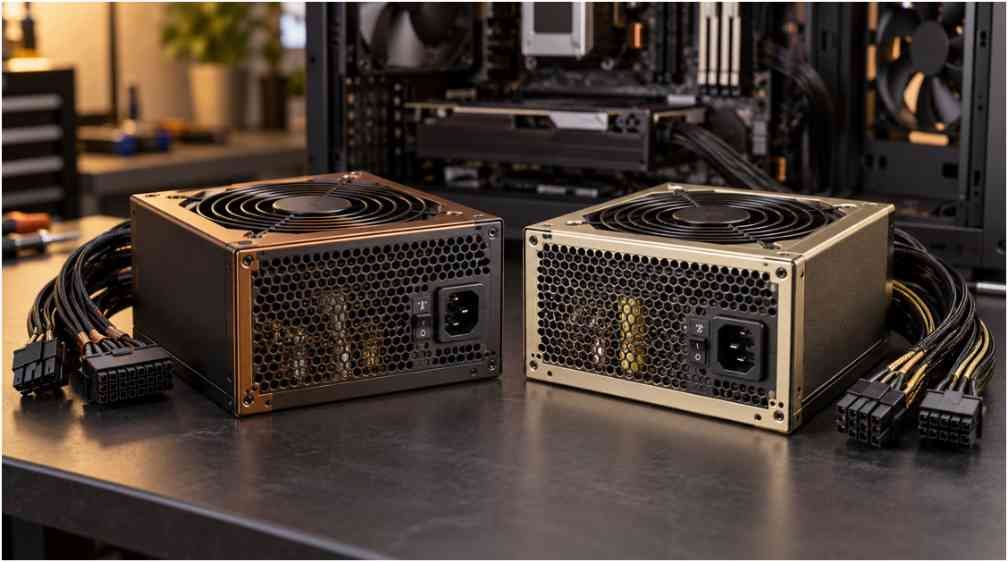
A Gold label looks like an easy upgrade when I compare parts for a PC build. But does it save enough electricity to justify its price? With gold certified vs bronze certified power supplies, the measurable difference is conversion efficiency. The better purchase depends on your actual power use, the price gap, and the quality of each specific model.
What the 80 Plus Ratings Measure
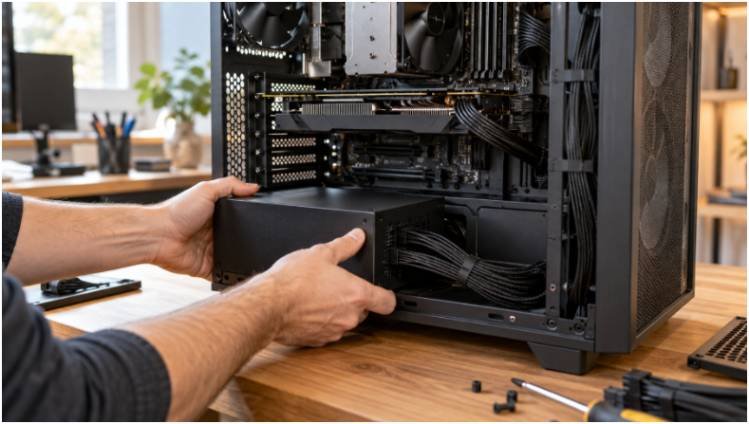
A power supply converts AC electricity from the wall into DC power for your components. Some electricity becomes heat during that conversion. An 80 Plus rating sets minimum efficiency levels at specified loads; it does not measure how fast your PC runs.
The percentages refer to output power divided by wall power. If your components need 400 watts and the PSU operates at 80% efficiency, it draws 500 watts from the outlet. The extra 100 watts is conversion loss.
Bronze and Gold Efficiency at Three Loads
For the 115V internal non-redundant category relevant to typical US desktop comparisons, 80 Plus lists these minimums
| Share of PSU’s rated output | 80 Plus Bronze | 80 Plus Gold |
| 20% load | 82% | 87% |
| 50% load | 85% | 90% |
| 100% load | 82% | 87% |
Gold’s requirement is five percentage points higher at each listed load. These are certification minimums, not a promise that every Gold unit performs identically. Results also depend on load and the applicable test category. Check the category when comparing published reports.
A common mistake is to call 50% load “typical gaming.” It means half of that PSU’s rated output. A system drawing 400 watts of DC power puts an 800-watt PSU at 50% load. It puts a 1,000-watt PSU at 40%. The game alone does not determine the percentage.
What Five Efficiency Points Mean for Your Bill
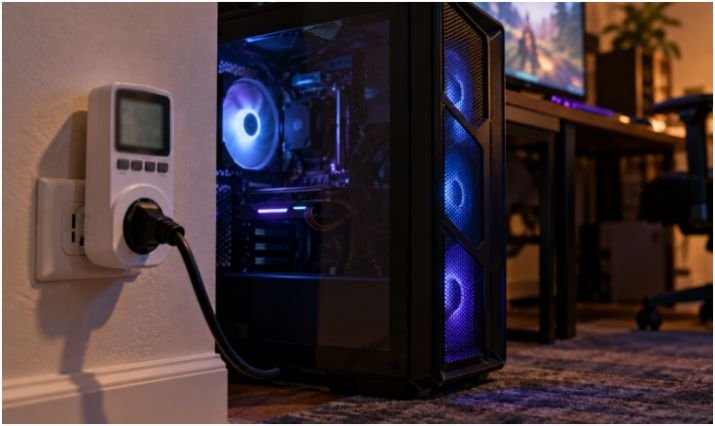
Gold wastes less electricity as heat at the same output load. That can matter in a warm room or a PC used for long work sessions. It does not mean a Gold PSU supplies more power to a GPU with the same rated output wattage.
A Worked Gaming PC Example
Suppose a PC’s components draw 400 watts while gaming. For a simple comparison, assume the Bronze unit operates at 85% efficiency and the Gold unit at 90%.
| Calculation | Bronze | Gold |
| Power delivered to components | 400 W | 400 W |
| Approximate draw from the wall | 471 W | 444 W |
| Approximate conversion loss | 71 W | 44 W |
Gold saves about 26 watts while the PC sustains that load. At four hours a day for 365 days, that is roughly 38 kilowatt-hours per year. At an illustrative electricity rate of $0.20 per kilowatt-hour, the difference is about $7.60 annually.
I would use that figure as a buying calculation, not a forecast. A real PC changes load constantly. Efficiency changes with load, and your local utility rate may differ. If Gold costs $30 more, electricity savings alone would take about four years under these assumptions. If the PC spends less time at 400 watts, payback may take longer.
This is why I would calculate from estimated component draw and daily use. Applying “five percent savings” to the PSU’s advertised 750-watt or 850-watt capacity gives the wrong answer.
Heat, Noise, and Build Quality
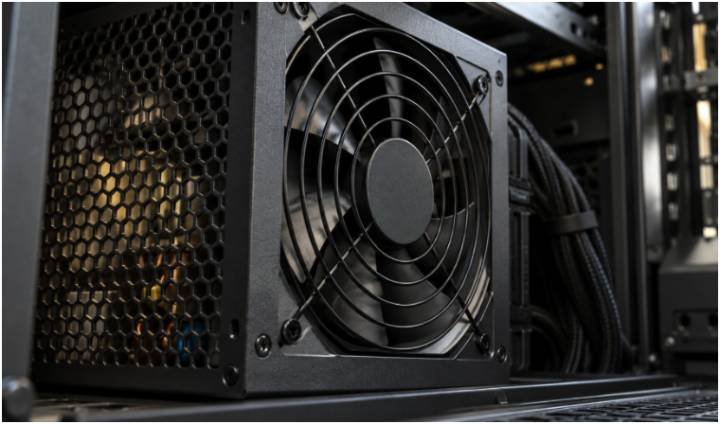
Less conversion loss means less heat produced inside the PSU at a comparable operating point. In the example above, the difference is about 27 watts. That can reduce the cooling work required of the PSU fan.
It does not guarantee a quieter computer. Fan size, fan curve, ventilation, and the particular model all affect noise. Cybenetics measures PSU efficiency and acoustics through separate evaluations, which is useful when quiet operation matters to your purchase.
What the Certification Cannot Tell You
The 80 Plus badge does not certify voltage regulation, ripple suppression, capacitor quality, protection behavior, warranty length, or modular cables. I would compare those features separately before paying more for Gold. A well-reviewed Bronze model can be a better purchase than a poorly documented Gold model.
The same applies to gaming stability. Modern graphics cards can place brief, high demands on a power supply. Intel’s ATX design guidance discusses these power excursions. An efficiency badge alone does not establish how a unit handles them.
For additional model-specific evidence, I would check independent reports that cover noise and protection behavior. Cybenetics describes its separate safety and operating checks; an efficiency rating should not be treated as a substitute for those checks.
How to Choose for Your PC
Bronze can make sense when it leaves room in a tight build budget and the specific unit meets your wattage, connector, and quality requirements. Gold becomes easier to justify when the price gap is small, you use the PC heavily, or you prefer a model whose other features also suit your build. Neither tier automatically comes with a particular warranty or cable design.
Check Wattage and Connectors First
Estimate your CPU, GPU, and other component needs before comparing efficiency labels. Use a fully modular power supply unit wattage calculator as a planning starting point, then check the GPU maker’s recommendation and the PSU’s actual connectors. Replace that placeholder with your published internal URL.
Also check case clearance and cable routing. Fully modular cables make installation tidier, but modularity is a model feature, not a Gold requirement. If your build uses an Intel desktop platform, confirm the motherboard and processor pairing through your LGA 1700 CPU socket compatibility article before finalizing the parts list. Replace that placeholder with your published internal URL.
Avoid choosing a PSU so close to your expected peak demand that routine upgrades leave no room. Equally, buying far more capacity than needed does not make Gold savings larger. What matters for the efficiency comparison is the load where the system actually operates.
Frequently Asked Questions
1. Does Gold save enough electricity to pay for itself?
Sometimes. Divide the price difference by your estimated annual electricity savings; the result is an approximate payback period.
2. Is Gold always quieter than Bronze?
No. Gold has lower minimum conversion losses at the specified loads, but fan design and cooling behavior determine audible noise.
3. Can a Bronze PSU power a high-end gaming PC?
Yes, if the specific model has suitable output capacity, connectors, and verified performance for the components.
4. Are gold certified vs bronze certified power supplies different in reliability?
The certification does not rate reliability. Compare model-specific testing, protection features, and warranty terms.
The Badge Is Only the Beginning
I would buy Gold when its efficiency and the specific model’s features justify the extra cost. I would buy a sound Bronze unit when the savings are modest and the budget has better uses. Start with your component wattage, compare the exact models, and do the electricity math using your own hours and utility rate.
Leave a Reply