
Most software failures do not begin with a programmer typing bad code. They often begin earlier—with unclear requirements, unrealistic schedules, weak architecture, incomplete testing, or security decisions postponed until release.
That is why understanding what is the software development life cycle matters far beyond the engineering department. The software development life cycle, commonly shortened to SDLC, is a structured process teams use to turn an idea into functioning software, release it safely, and continue improving it after customers begin using it.
The exact number of stages varies between organizations, but the underlying principle remains simple: important decisions should happen deliberately rather than accidentally.
What Does the Software Development Life Cycle Actually Do?
An SDLC divides software creation into manageable phases with specific goals, responsibilities, and outputs.
IBM describes SDLC as a structured, repeatable approach for developing, delivering, and maintaining software. AWS similarly emphasizes its role in reducing project risk through planning and measurable development activities.
Think about a bank building a new mobile deposit feature. Developers cannot simply start coding a camera button. The bank first needs to understand customer requirements, fraud risks, regulatory considerations, system integrations, image-processing needs, accessibility, testing conditions, deployment procedures, and ongoing support.
SDLC provides the framework for answering those questions in an organized way.
The Seven Core Stages of SDLC
Different organizations combine or rename individual phases, but seven stages capture the process used by many software teams.
| SDLC stage | Main question | Typical outcome |
| Planning | Should we build it? | Scope, budget, schedule |
| Requirements | What must it do? | Requirements specification |
| Design | How will it work? | Technical architecture |
| Development | How do we build it? | Working code |
| Testing | Does it work correctly? | Verified software |
| Deployment | How do users receive it? | Production release |
| Maintenance | How do we keep it reliable? | Updates and fixes |
1. Planning Tests Whether the Idea Makes Sense

Planning determines the project’s purpose, scope, cost, staffing needs, technical feasibility, and major risks.
A US retailer considering a new inventory-management application, for example, might estimate the number of stores involved, required integrations, development costs, expected savings, implementation schedule, and cybersecurity exposure before approving development.
Good planning also defines what the first version will not include. That boundary helps prevent uncontrolled scope growth.
Planning also depends on having a practical level of digital competence across the team. Understanding what are some basic software skills can help clarify the everyday abilities people need to work with documents, spreadsheets, files, collaboration tools, and other software during a project.
2. Requirements Turn Business Needs Into Specific Expectations
Requirements analysis translates broad ideas such as “customers need faster checkout” into measurable capabilities.
Teams gather input from customers, product managers, business analysts, security personnel, developers, operations teams, and other stakeholders. Requirements may cover features, performance, accessibility, privacy, compatibility, reliability, and security.
Poor requirements create an expensive problem: developers can successfully build software that solves the wrong problem.
3. Design Creates the Technical Blueprint
Design converts requirements into architecture.
Engineers decide how databases, interfaces, APIs, cloud services, authentication systems, network components, and application modules will interact.
Security should already be part of these decisions. NIST’s Secure Software Development Framework notes that many traditional SDLC models do not address security deeply enough on their own and recommends integrating secure-development practices throughout the life cycle.
4. Development Turns the Blueprint Into Software
Only after substantial planning does the most visible stage begin: coding.
Developers create application components, databases, integrations, interfaces, and supporting services. Modern teams usually combine coding with version control, peer review, automated builds, dependency checks, and continuous integration.
Development is therefore more than writing code. It is controlled implementation against previously agreed requirements and designs.
For people new to development, it helps to understand the fundamentals before diving deeply into code. This resource on learning about software for beginners explains how software, hardware, operating systems, applications, files, and basic programming concepts fit together.
5. Testing Looks for More Than Bugs
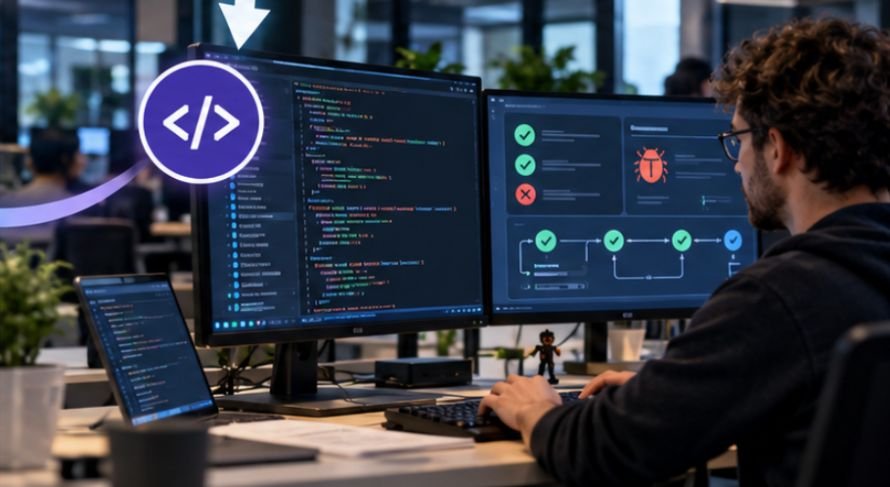
Testing asks whether software behaves as intended under expected—and sometimes unexpected—conditions.
Testing also applies to the files and resources used during development and everyday software workflows. Knowing how to scan a file before opening it can add an extra safety check when working with downloaded files, attachments, or other potentially untrusted content.
Teams may conduct unit testing, integration testing, system testing, usability testing, performance testing, regression testing, security testing, and user acceptance testing.
A payment system, for instance, should not merely complete a transaction successfully. Testers may check what happens when the network disconnects halfway through, a customer submits a payment twice, invalid data is entered, or thousands of transactions arrive simultaneously.
Carnegie Mellon University’s Software Engineering Institute has long documented the importance of incorporating security processes and assurance practices into software development.
6. Deployment Moves Software Into Production
Deployment makes an approved software version available to actual users.
That might involve publishing a mobile application, moving code to cloud infrastructure, activating a feature gradually, migrating databases, or updating thousands of company computers.
Release strategy matters because even thoroughly tested software can behave differently in a production environment.
CISA recommends verified deployment processes, including appropriate testing and measurement, as part of the development lifecycle.
US organizations can review related guidance through CISA software security resources.
7. Maintenance Begins After Launch, Not Before It
A release is rarely the end of software development.
Operating systems change. Browsers update. New vulnerabilities appear. Customers discover unexpected workflows. Business requirements evolve.
Maintenance therefore includes bug fixes, performance improvements, security patches, compatibility updates, infrastructure changes, monitoring, and new features.
For long-lived systems, maintenance may consume far more time than the initial release.
Waterfall, Agile, and DevOps Are Different Ways to Run the Life Cycle

One common misconception is that Agile replaces SDLC. It does not.
SDLC describes the overall lifecycle. Waterfall, Agile, iterative development, Spiral, DevOps, and related approaches determine how teams move through that lifecycle.
Waterfall generally progresses through major phases sequentially. It can work well where requirements are stable and extensive documentation is important.
Agile repeats smaller cycles of planning, design, development, testing, and feedback. Teams can therefore adjust more quickly when requirements change.
DevOps connects development with IT operations and heavily emphasizes automation, continuous integration, continuous delivery, monitoring, and frequent releases. OWASP notes that DevOps commonly automates many SDLC activities through CI/CD pipelines.
A Simple SDLC Test Before Starting a Software Project
You do not need a large engineering organization to apply SDLC thinking.
Before development begins, ask seven questions:
- What specific problem are we solving?
- Who will use the software?
- What measurable requirements must it satisfy?
- What architecture and technologies support those requirements?
- How will developers verify their work?
- What must happen before production release?
- Who owns monitoring, security, fixes, and eventual retirement?
If a team cannot answer several of these questions, coding is probably starting too early.
Where SDLC Can Go Wrong
A defined process does not guarantee successful software.
Teams can document requirements nobody validates, conduct testing too late, follow Agile ceremonies without gathering meaningful customer feedback, or automate deployments without adequate safeguards.
Another mistake is treating lifecycle stages as isolated handoffs. Real software development contains feedback loops. Testing may expose a design problem. Customer feedback may change requirements. A security discovery may send developers back to architecture.
The goal is therefore not rigid adherence to seven boxes. It is disciplined decision-making throughout the product’s life.
Frequently Asked Questions
1. What is the software development life cycle in simple terms?
It is a structured process for planning, designing, building, testing, releasing, and maintaining software so teams can control quality, cost, risk, and requirements.
2. How many stages does SDLC have?
Many explanations use six or seven stages. The names and number vary because organizations may combine planning with requirements or divide testing, deployment, operations, and maintenance differently.
3. Is Agile the same as SDLC?
No. SDLC describes the overall software lifecycle. Agile is one approach teams can use to move repeatedly through activities such as planning, development, testing, and feedback.
4. Why is security important in SDLC?
Integrating security throughout development helps teams identify vulnerabilities earlier, improve software assurance, and reduce the risk of discovering major security weaknesses immediately before or after release.
Final Takeaway
The important lesson behind what is the software development life cycle is not memorizing seven stage names. It is recognizing that reliable software is the result of a controlled sequence of decisions.
Planning reduces wasted work. Requirements clarify the target. Design prevents architectural improvisation. Testing challenges assumptions. Deployment controls release risk. Maintenance keeps the product useful long after launch.
The strongest software teams also treat the lifecycle as a feedback loop rather than a one-way assembly line. Before the first line of code is written, they already know what problem they are solving, how success will be measured, and who will keep the software dependable after users arrive.
Leave a Reply